Thirty years ago, the Turkestan cockroach made its way from Asia to
the U.S., becoming the most common and predominant cockroach in the
Southwest, invading homes, barns and entire apartment complexes. Romero
has been researching this pest for two years, trying to find ways to
control it.
The Turkestan cockroach is a regularly seen in compost piles, leaf
litter, potted plants, sewers, water-meter boxes, hollow block walls and
under broken pavement.
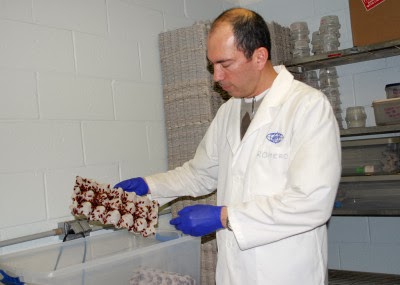
In the lab, the colonies of Turkestan and other cockroaches, which
are mostly gathered by putting sticky traps around the building or in
the field, are kept in plastic or glass aquarium containers, feeding on
dog food and water. The hundreds of cockroaches stay together inside
cardboard egg cases, scattering as soon as they sense movement.
Turkestan cockroaches, which Romero has been collecting for three
years, were first reported in California, Texas and Arizona and
reproduce quickly, taking 6 months to grow to adult stage.
“Unfortunately there is not much information about this cockroach,â€
he said. “The most striking fact about Turkestan cockroaches is how well
they have adapted to our climate and dry conditions and also their
presence all year. Turkestan cockroaches also develop much faster than
some other local cockroaches and this explains why they are more
abundant.â€