
So good they named it once
Oecanthus pellucens (Scopoli, 1763) - the Italian tree cricket - was recently found breeding in Dungeness, Kent, UK (Sutton, Beckmann & Nelson, 2017).There are a number of recordings of this species in the BioAcoustica repository: recordings of Oecanthus pelluscens on BioAcoustica.
Like many tree crickets it has a certain translucent quality, and it is this that Giovanni Antonio Scopoli alludes to when giving it the specific name pellucens. Torre-Bueno's A Glossary of Entomology gives the definition:
pellucid, pellucidity, pellucid, transparent, whether clear or coloured.(This definition is somewhat incorrect, something transparent is clear, it can be coloured or colourless, but I digress)
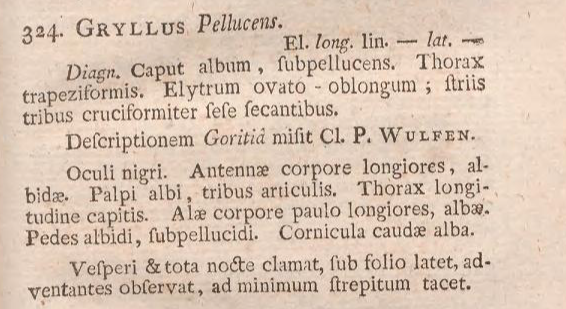
That Scopoli refers to this property is clear in the original description: "Caput album, subpellucens". Subpellucens is best translated as opaque.
All very well, but so far not particularly interesting. The (minor for most) interest comes from an alternative definition of pellucid, here borrowed form the Oxford English Dictionary.
Of music or other sound: clear and pure in tone.Crickets in general are known for their pure bell like songs, and that of Oecanthus pelluscens is no exception. Shown below are three chirps from the recording above (time on x-axis, frequency on y-axis). This shows a strong resonance frequency, with three clear, regularly spaced, harmonics: a clear and relatively pure tone indeed.
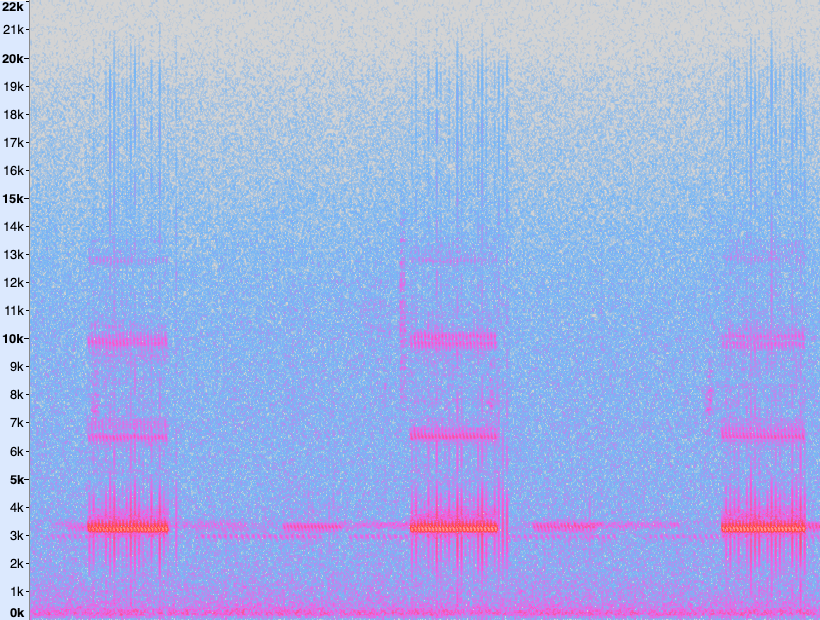
Oecanthus pelluscens, a cricket so clear and pure it could be named just once.